Hiki: Autism ADHD & ND Dating
Social · HIKI, INC.

Hiki: Autism ADHD & ND Dating screenshots


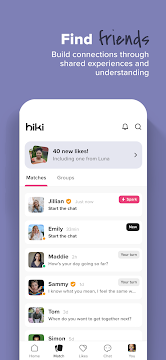


Most dating apps treat neurodivergence as an afterthought, something you mention in a bio and hope the other person handles well. Hiki takes the opposite approach: it is a friendship and dating platform built specifically for autistic, ADHD and other neurodivergent adults, and that shared starting point shapes everything from who you see to how you present yourself. If you have been diagnosed recently, identify as self-diagnosed, or have long embraced an autistic, ADHD or otherwise neurodivergent identity, this is the audience the app is designed around.
The app is free to join, carries no ads, and offers in-app purchases, with a premium tier that expands what you can do. It has been available since July 2019 and shows more than 100,000 installs on Google Play, with a 3.5 average across roughly 4,000 ratings. The developer describes it as the first platform of its kind, and that framing matters: the appeal here is not a bigger pool of matches but a pool where the baseline assumption is that you do not have to explain yourself.
Finding friends before finding romance
Hiki is not only a dating app. The developer positions friendship as a first-class goal, so you can meet, match and chat with people without any romantic expectation attached. That is unusual for the category, where the assumption is usually that every match is a potential partner. For someone who moved to a new city, or who has struggled to keep friendships going in environments that reward small talk, having a space where the stated purpose is connection rather than courtship lowers the pressure considerably.
The matching itself is meant to work from your preferences, your special interests and your personality rather than from photos alone. I like that emphasis, because shared interests give a conversation somewhere to start, and the developer frames the community as a place to unmask and be yourself rather than perform a version of yourself for strangers. The practical result, as I read it, is an app where the profile is doing more work than the picture.
A community feed alongside the matches
Beyond one-to-one matching, Hiki includes a community page where you can post, react and comment. This is the part that gives the app a life outside of waiting for a match to message back. You can read what other neurodivergent adults are talking about, join in, and get a sense of the room before committing to a private conversation. For anyone who finds the silence of a traditional dating app demoralizing, a feed that keeps moving is a meaningful difference.
The developer also lets you create or join group chats, which extends the same idea to smaller circles. A group chat is a gentler entry point than a direct message, since the attention is spread across several people rather than landing entirely on you. Between the feed and the group chats, there is a route into the community that does not depend on being chosen by a single match.
Who the app is built to include
The welcome mat is deliberately wide. Autistic, ADHD and AuDHD users are the core audience, and the developer also names Tourette's, dyslexia and any other neurodivergence, alongside LGBTQIA+, gender non-conforming and non-binary people. Discriminatory filtering is not allowed in the app, which tells you something about the kind of environment it is trying to hold together. If you have spent time on mainstream platforms filtering yourself down to the most palatable version of your profile, the contrast should be obvious.
The age rating is Mature 17+, which fits a platform where adults are looking for friendship, dating and community in equal measure. This is not a service for teenagers or for parents seeking support on a child's behalf. It is aimed at adults who want to make connections on their own terms, whether that means a partner, a friend or simply a group of people who understand the way your brain works.
Safety tools and how the app is policed
The developer puts safety near the front of its pitch and describes security measures including location, age and ID verification. Bullying, discrimination and abuse are not tolerated. You can block or report interactions that make you uncomfortable, and the developer's framing is that you control your own experience on the platform. For a community that includes people who may be more vulnerable to exploitation or harassment, those controls are not decorative.
Verification is also tied to the premium tier, where a profile verification option is listed among the paid features. The paid tier is where the developer puts some of the tools aimed at making people feel safer about who they are talking to. How much that matters to you will depend on how cautious you prefer to be when meeting strangers.
What premium adds, and what it costs you
Joining is free, and the app carries in-app purchases instead of ads. Hiki Premium is the paid layer, and it adds a fairly specific set of extras: profile verification, profiles that let you define your neurodivergent traits, support needs and communication preferences, a personalized message with your match requests, seeing everyone who has liked you, sending a Spark to get noticed faster, a profile boost that skips the queue, viewing new profiles in other cities, video messages to matches, and responding to prompts with text, audio or video.
Two of those stand out to me. Being able to spell out your traits, support needs and communication preferences is the kind of detail that makes a profile genuinely useful to the person reading it, and the option to answer prompts in audio or video gives people who find typing a poor fit for their thoughts a way to present themselves properly. The rest, from seeing your likes to boosting your profile, is the familiar mechanics of paid visibility. None of it is required to use the app, but the free tier and the paid tier are clearly not the same experience.
What you need before you start
Getting in is straightforward: the app is free to download and join, and there is no ad layer to work around. Verification uses location, age and ID. The app is rated Mature 17+, which sets the tone for who it is meant for.
One practical point the developer raises directly is geography. With nearly 200,000 active users worldwide, Hiki is a global platform, but the developer acknowledges that your city may not have caught on yet and suggests inviting others if the local pool is thin. That is an honest note to include, and it is worth taking at face value: the size of your nearby community will shape how quickly the app becomes useful to you. Premium's option to view new profiles in other cities speaks to the same problem.
If you are deciding whether to install it, the question is less about the latest release and more about whether a neurodivergent-first community is what you have been missing.
A strong fit if neurodivergence is your starting point
Hiki makes the most sense for neurodivergent adults who want friendship and dating in the same place, and who would rather build connections from shared experience than from a general-purpose pool. The community feed and group chats give you something to do while matches develop, and the profile tools, particularly on the premium side, let you describe how you communicate rather than leaving it to be guessed. The developer's stated aim is a space where being atypical is the norm, and the feature set is consistent with that aim.
The caveats are worth holding alongside the pitch. The rating sits at 3.5 from roughly 4,000 ratings, which is a middling score for an app with this much ambition, and the developer itself warns that local adoption varies. Premium is where several of the more interesting profile and messaging options live, so the free experience is a starting point rather than the full picture. If you are in a city where Hiki has taken hold, or you are willing to help it grow there, it offers something the mainstream apps do not.
The short verdict
A thoughtful, neurodivergent-first dating and friendship app that works best where its local community has already grown.
What's new in version 4.0.28
Bug fixes and performance improvements
App specs
- Version4.0.28
- UpdatedOctober 4, 2026
- Downloads100K+
- RequiresAndroid 8.0+
- PriceFree
- Age ratingMature 17+
Hiki: Autism ADHD & ND Dating: frequently asked questions
Is Hiki only for dating?
No. It works as both a friendship app and a dating platform, and friendship is treated as a goal in its own right. You can meet, match and chat with people without a romantic framing, and the community feed and group chats add ways to connect that are not one-to-one. If you are looking for friends rather than a partner, the app is built to accommodate that.
Who is Hiki designed for?
It is aimed at neurodivergent adults, with autistic, ADHD and AuDHD users as the core audience. The developer also names Tourette's, dyslexia and other forms of neurodivergence, and welcomes LGBTQIA+, gender non-conforming and non-binary people. The content rating is Mature 17+, so it is intended for adults rather than younger users.
What does Hiki Premium include?
Premium includes profile verification, profiles that define your neurodivergent traits, support needs and communication preferences, a personalized message with match requests, seeing everyone who has liked you, sending a Spark, a profile boost that skips the queue, viewing profiles in other cities, video messages to matches, and answering prompts with text, audio or video. The app is free to join and carries in-app purchases instead of ads. Premium is optional, but several of the more detailed profile and messaging options sit inside it.
How does Hiki handle safety?
Security measures include location, age and ID verification, and bullying, discrimination and abuse are not tolerated. You can block or report interactions that make you uncomfortable, and you control your experience on the platform. Profile verification is also offered as part of the premium tier.
What if there are not many Hiki users near me?
There are nearly 200,000 active users worldwide, but some cities have yet to adopt the app, and inviting others is suggested to help it grow locally. Premium includes the ability to view new profiles in other cities, which addresses the same problem. How useful the app feels to you will depend a good deal on how many people near you are using it.
Pros
- Built specifically for neurodivergent adults
- Friendship and dating in one platform
- Community feed, reactions and group chats
- Block and report tools with zero tolerance policy
- Free to join with no ads
Cons
- Premium includes several profile and messaging tools
- Local user base varies by city
- Mature 17+ rating limits the audience
- 3.5 average from roughly 4,000 ratings
Download Hiki: Autism ADHD & ND Dating
by HIKI, INC.
Free · In-app purchases · Official store listings


