Doctor On Demand
Medical · Doctor On Demand, Inc

Doctor On Demand screenshots
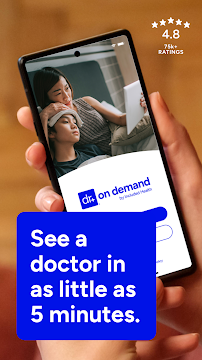


Doctor On Demand is a telehealth app from Included Health that puts video visits with US-based, board-certified doctors, therapists and psychiatrists on your phone, tablet or computer. The pitch is simple: when something needs medical attention and you would rather not sit in a waiting room, you open the app and connect face to face with a provider. Visits run around the clock, every day of the year, including weekends and holidays.
The reason to consider it is speed and range in one place. Urgent care concerns such as colds, flu, allergies, headaches, skin problems and urinary tract infections sit alongside mental health visits for stress, anxiety, depression, trauma and grief. If a prescription is medically appropriate, the provider can send it to a pharmacy near you, and lab orders or screenings go to nearby facilities. For a lot of everyday problems, that covers the whole errand.
It is free to download, carries no ads and has no in-app purchases, so nothing is sold inside the app itself. Payment for care happens as part of the visit, either through insurance or as a self-pay patient, and the developer says you see the exact cost before you commit. The app has been on Google Play since October 2013 and sits at a 4.9 average from 89,662 ratings.
Who ends up using it
The clearest fit is someone with a routine problem that does not need an emergency room but does need a professional opinion today. A parent whose child has a fever at midnight, a traveler who picks up a sinus infection far from home, or an office worker who cannot take a half-day for a nagging rash all get the same basic offer: a provider on screen in minutes rather than an appointment next week.
The second group is people who want mental health support without the usual wait. The developer notes that therapy and psychiatry appointments are often available within days, which is a different experience from calling around for a clinician with an opening. Anyone managing anxiety, depression, stress or grief who has found the traditional route slow may find the pace here more workable.
A third group is anyone who needs paperwork rather than treatment. A doctor's note for work or school is one of the stated reasons to book an urgent care visit, and prescription refills and lab orders are handled through the same channel. If your need is administrative as much as medical, the app is built to cover it.
That said, this is not a replacement for emergency care or for a specialist you see in person. The developer is explicit that providers cannot prescribe controlled substances, so anyone hoping for that kind of prescription will need another route. And while the roster spans many specialties, the model is virtual visits, not ongoing hands-on examination.
Seeing a doctor without leaving the house
The core of the app is the video visit. After signing up for a free account, you either take the first available provider or schedule a visit for a time that suits you. The developer says a connection can happen in as little as ten minutes, which is the number that matters most if you are unwell and decide to deal with it now rather than later.
Once you are on the call, the shape of it mirrors an in-person appointment. The provider asks how you are feeling, goes through your health history and proposes a treatment plan. Where medication is appropriate, a prescription goes to a pharmacy close to you; where further investigation is needed, labs and screenings are ordered at nearby facilities. The same session can cover a note for an employer or school.
The conditions listed are the ordinary ones that fill up clinics: colds, flu and sinus infections, UTIs, acne and rashes, allergies and asthma, headaches and migraines. There is also support for longer-term concerns such as high cholesterol, diabetes and thyroid screening, plus prescription refills and lab orders. It is a broad list aimed at the everyday rather than the exotic.
The provider pool is described as US-based and board-certified, with an average of 15 years of experience across a range of specialties. That matters for trust, since a video visit only works if you believe the person on the other end can handle what you bring them. The service follows HIPAA guidelines for protecting health information.
Therapy and psychiatry on a screen
Mental health is treated as a first-class part of the service rather than an add-on. Licensed therapists and psychiatrists take virtual appointments for stress, anxiety, depression, PTSD, trauma and loss, along with relationship difficulties. These are scheduled visits, which makes sense given how therapy works.
The practical advantage is availability. The developer says mental health appointments usually come within days, unlike the weeks a traditional provider may take. For someone who has been putting off asking for help because of the scheduling friction, that gap is the whole argument for trying an app like this.
It is worth setting expectations about what a video session can be. You are talking with a clinician remotely, which suits assessment, ongoing therapy and medication management, but it is not the same as being in a room with someone. For many people that trade is fine, and for some it is easier to speak openly from home. The app's role is to remove the logistics, not to change what therapy is.
The same prescribing limit applies here as elsewhere: controlled substances are off the table. Anyone whose treatment depends on that class of medication will need to keep an in-person clinician in the picture. For everything else in the stated range, the virtual format is the point rather than a compromise.
What a visit costs
The app is free to download, with no ads and no in-app purchases. What you pay for is the care. Doctor On Demand works with major health plans and many employers, which can lower the cost for eligible members, and the exact visit price is shown before you book.
If you are not covered, the service is offered on a self-pay basis. That last phrase is the one to hold them to: the promise is that you know the number up front rather than discovering it afterward. Whether your particular plan counts a virtual visit the same as an office visit is a question for your insurer, not the app.
Because everything is settled around the visit itself, there is nothing to unlock inside the app and no upsell to click past. That is a cleaner arrangement than many medical apps offer, and it means you can install it, create an account and see what a visit would cost you before deciding anything.
The free account is the starting point for all of it: download, sign up, then choose whether to see the first available provider or book a slot. There is no charge to have the app ready on your phone for the next time something comes up.
How it compares with the alternatives
The obvious comparison is a walk-in clinic or urgent care center. Those can handle more than a video call can, including physical exams and procedures, but they cost you travel and waiting time, and they may not be open when the problem appears. Doctor On Demand's advantage is that it is available at any hour and comes to you.
Against a regular family doctor, the trade is continuity versus access. Your own physician knows your history and can see you in person, but getting a same-week appointment is often the hard part. The app is better understood as a layer on top of that relationship for the moments when waiting is not practical, rather than a replacement for it.
For mental health specifically, the alternative is usually a therapist or psychiatrist with a waiting list. The developer's claim of appointments within days is the differentiator here, and it is the kind of thing that matters most to someone who has already decided to seek help. A dedicated in-person practice may still suit people who want a standing weekly hour in the same room.
There are also general-purpose telehealth services from insurers and hospital systems. What Doctor On Demand offers is its own network of providers, its own scheduling and its own pricing, with urgent care and mental health under one roof. If your insurance already includes a telehealth benefit, it is worth checking which one your plan prefers before you book.
A reasonable first stop for everyday care
Doctor On Demand is worth installing if you want a doctor, therapist or psychiatrist reachable by video without rearranging your day. The combination of round-the-clock urgent care, scheduled mental health visits, prescriptions sent to a nearby pharmacy and doctor's notes covers a large share of the reasons people end up in a clinic. The free download, absence of ads and lack of in-app purchases make it easy to keep on your phone for when you need it.
It suits people with insurance through a participating plan or employer, and self-pay patients who want to know the price before the visit. It also suits anyone who has found it hard to get a timely mental health appointment elsewhere. The prescribing limit on controlled substances is the main thing to know going in, along with the fact that virtual care is not emergency care.
With over a million installs and a 4.9 average from a large body of ratings, the app has clearly found an audience. My advice is to set it up and check your visit cost now, while nothing is wrong, so the decision is already made when something is.
The short verdict
A well-established telehealth app for everyday urgent care and mental health visits, best for people who want care quickly and know their cost upfront.
What's new in version 2026.40.2
This release includes several bug fixes and performance improvements.
App specs
- Version2026.40.2
- UpdatedOctober 8, 2026
- Downloads1M+
- RequiresAndroid 10+
- PriceFree
- Age ratingEveryone
Doctor On Demand: frequently asked questions
What can Doctor On Demand treat?
The urgent care side covers everyday problems such as colds and flu, sinus infections, urinary tract infections, allergies, asthma, headaches, migraines, acne and rashes. Providers can also order labs and screenings for preventive care and help manage conditions like high cholesterol, diabetes and thyroid issues. Therapists and psychiatrists handle stress, anxiety, depression, PTSD, trauma and grief, among other concerns.
How quickly can I see a provider?
Urgent care visits are available around the clock, every day of the year, and you can connect with a provider in as little as ten minutes. You can either take the first available clinician or schedule a visit for later. Mental health appointments are typically open within days rather than the weeks a traditional practice might need.
How much does a visit cost?
The app is free to download and there are no in-app purchases, so the cost is the visit itself. Doctor On Demand works with major health plans and many employers, which can reduce what eligible members pay, and the exact price is shown before you book. If you are not covered, self-pay visits are offered at set rates.
Can I get a prescription through the app?
Yes, when it is medically appropriate. The provider can send a prescription to a pharmacy near you, and refills and lab orders are handled the same way. One limit is stated clearly: providers are not able to prescribe controlled substances. If your treatment depends on that type of medication, you will need to arrange it through another clinician.
Can I get a doctor's note for work or school?
That is one of the stated reasons to book an urgent care visit. You see a provider by video, discuss your symptoms and history, and the note is handled as part of that appointment. The same visit can cover a treatment plan or a prescription if one is needed.
Pros
- Providers available 24/7, including holidays
- Urgent care and mental health in one app
- Exact visit cost shown before you book
- Prescriptions sent to nearby pharmacies
- Free download with no ads or purchases
Cons
- Controlled substances cannot be prescribed
- Mental health visits are scheduled, not on demand
- Cost depends on your insurance coverage
Download Doctor On Demand
by Doctor On Demand, Inc
Free · Official store listings


